
There’s a specific moment: you open your to-do list and today’s items are stacked right on top of yesterday’s leftovers. Cross one off, and the next one fills its spot immediately.
You clearly did things all day, and by the time you’re done, you can barely remember what any of it actually was.
The World Health Organization’s 2019 classification of burnout describes it as resulting from “chronic workplace stress that has not been successfully managed,” and lists reduced professional efficacy as one of its three core dimensions, alongside exhaustion and cynicism.
Burnout often shows up less from a feeling of “I didn’t do enough,” and more from this: no longer being able to see where any of it is going, which is exactly what erodes that sense of efficacy.
Doing more isn’t the same as knowing where you’re headed

The usual reaction to feeling buried under a to-do list is to break things down further, manage them tighter, push to get through more. But that usually just adds more items to manage.
If the actual reason you’re exhausted isn’t “not enough volume” but “no idea where any of this leads,” breaking things down even further only adds to the fatigue.
When you feel like you’re disappearing under everything you have to do, what you need isn’t a tool that slices the day into smaller pieces and pushes you harder.
It’s the opposite: looking back at what you’ve already done, and seeing what direction it’s actually been building toward.
In Gallup’s research on the top causes of burnout, unclear role clarity ranks third, right behind unmanageable workload. How much work there is matters, but so does knowing what it’s actually for.
WARNING Some exhaustion doesn’t go away with rest
Plain physical fatigue tends to lift after a few days off. Losing direction is different: if the same numbness shows up again the moment you’re back, more rest isn’t the fix. What you need first is to re-confirm where what you’re doing is actually headed.
What “unclear role clarity” actually means
Gallup’s third-ranked cause of burnout, unclear role clarity, doesn’t mean “I don’t know what I’m supposed to do.” Your to-do list items are usually specific enough on their own.
What’s unclear is which bigger goal or role those items are actually feeding into.
“Write the report,” “attend the meeting,” “reply to email” each tell you what to do today, but none of them tell you where that fits within your role this quarter.
This mismatch, plenty of clear tasks with no visible direction, ends up causing burnout far more often than an actually unclear role does.
This cuts sharper when you’re working alone
At a company, a manager or coworker sometimes answers “wait, why was I doing this again?” for you. A solo founder or freelancer has no one to fill that role.
Bounce between product, marketing, and finance on your own, and nobody confirms which goal today’s work is actually feeding into unless you check it yourself.
For a more concrete way to keep from losing direction when you’re running several areas alone, see A Goal-Task Tree for Solo Founders and Freelancers.
Confirming direction doesn’t need a grand ritual

Reclaiming direction sounds like it calls for an elaborate retrospective ritual or a polished weekly review template, but what it actually takes is much simpler.
Pick a few things you finished today and ask yourself, “where did this actually go?” If the answer comes immediately, direction is still alive.
If it doesn’t, or all you can say is “I did it because I had to,” that’s the sign direction is slipping.
If doing this daily feels like too much, five minutes once a week, right before you log off, is enough.
What matters isn’t the format; it’s the act of actually looking again at the connection between what you did today and where it’s headed.
When direction is visible, the same effort feels different
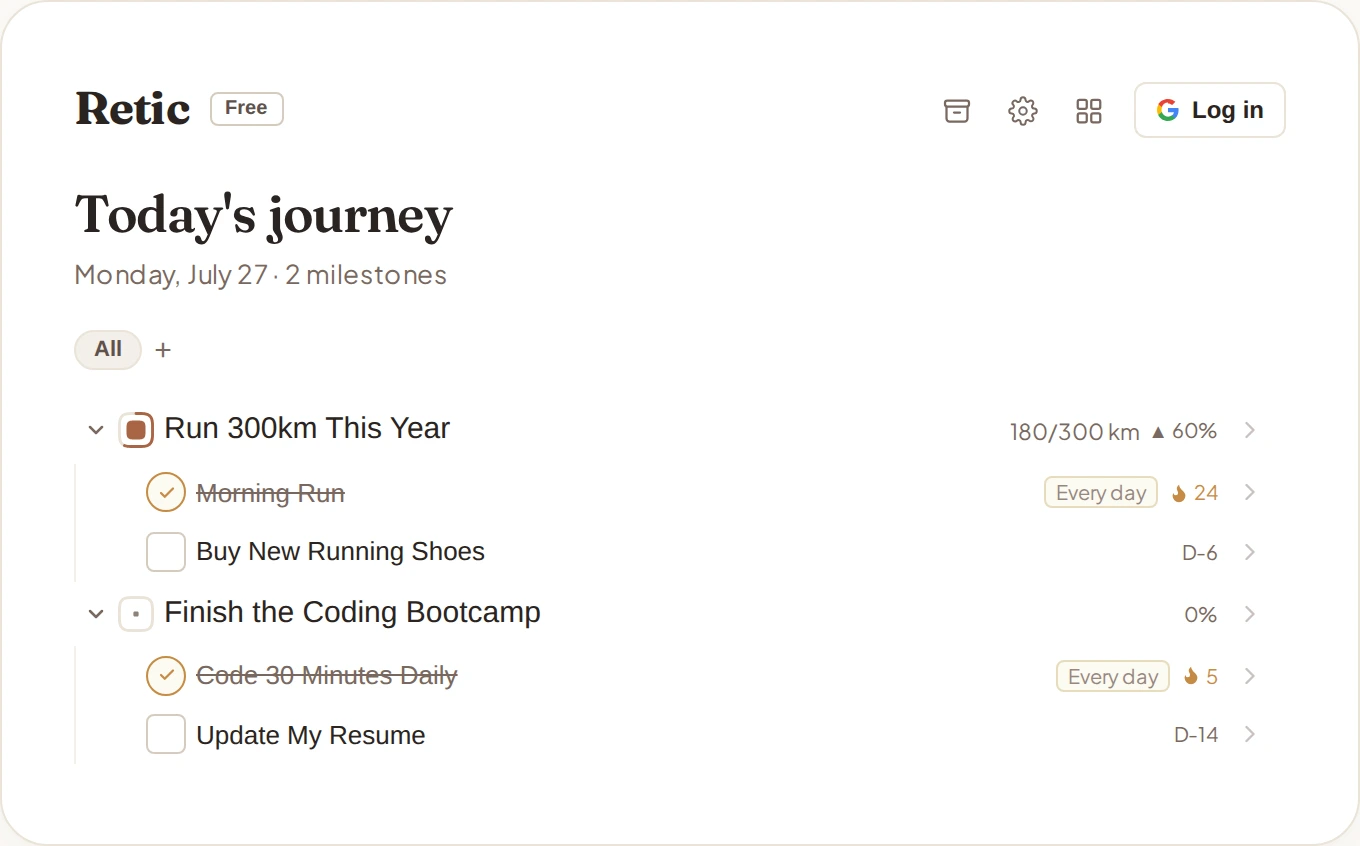
Do the same amount of work on a day where you can see where it’s going, versus a day where you can’t, and the two days land completely differently.
When you can confirm which goal the handful of things you finished today actually fed into, even a hard day settles as “still, I moved forward that much.”
Without that connection visible, no amount of work adds up to anything more than “today just passed.”
The space Retic wants to be is the first kind, not the second.
Somewhere that, within the same 24 hours everyone gets, lets you look back at what you’ve done well and land on a quiet certainty that you moved one step further than yesterday.
That’s what direction means here.
Being able to see, always, which goal any task or habit on today’s screen is feeding into isn’t really about doing more. It’s about knowing where you’re actually headed.
What burnout calls for isn’t a tighter to-do list. It’s re-confirming what you’ve already built, and which direction it’s pointing.