
On the train home, you remember you finished today’s task, drafting your resume, and open the app. You tap the checkbox.
A strikethrough appears, the item fades in today’s list. Feeling good, you switch over to the goal it belongs to: “Job search.”
The screen looks exactly like it did yesterday. The progress bar hasn’t moved. The percentage hasn’t changed.
You did it. So why does nothing look different?

This isn’t just mild annoyance. For a second, your sense of having accomplished something wavers. A doubt creeps in: “Did what I did today actually help with the job search, or not?”
Checkmarks keep piling up in your task list, while the goal above it seems frozen at whatever state it was in weeks ago.
Do this enough times, and the act of finishing a task quietly separates from the feeling of getting closer to a goal.
You keep checking things off, but you stop paying attention to where they’re actually going.
This isn’t about laziness or a lack of willpower. In most task apps, tasks and goals are simply two separate lists from the start.
A checkmark only means something inside its own list; there’s no channel for that information to reach the goal above it at all.
Harvard Business School’s Teresa Amabile and Steven Kramer analyzed roughly 12,000 diary entries from 238 employees across seven companies and found that feeling progress on meaningful work is the single biggest driver of daily motivation and emotion.
Progress has to be visible, not just real, to actually move you.
The moment it fills in right in front of you
Now picture it differently. You check off the same task: drafting your resume.
But this time, before you even switch screens, you see the progress ring for “Job search” fill in a little, right where you tapped.
You don’t have to navigate anywhere to confirm where today’s work went. It shows up on the spot.
That small difference changes how it feels. Because “I did it” and “I got closer” are confirmed in the same instant, you get immediate proof that today’s work wasn’t wasted.
And if you’re actually falling behind on a goal, you see that just as quickly, before it’s too late to do anything about it.
The mere feeling of being close can itself speed you up: in a Columbia Business School study led by Ran Kivetz, customers given a 12-stamp loyalty card with 2 stamps already filled in (still requiring the same 10 purchases) finished it faster than customers starting a blank 10-stamp card.
The actual distance was identical; only the sense of nearness changed.
NOTE Marking something “done” is different from progress moving
Progress fills in automatically the moment you check something off, but marking the goal or task itself complete is a separate thing. If even one sub-item is still open, the parent can’t be marked done, so a rising progress bar never tricks you into thinking something is finished before it actually is.
The gap widens when goals and tasks live in entirely separate apps
This gap happens even inside a single app, when tasks and goals are treated as different lists.
Split them across entirely separate apps, goal in Notion, tasks or habits checked off somewhere else, and the gap widens considerably.
Inside one app, at least switching screens is all it takes. Across two apps, even that few-second detour of logging in and navigating over starts getting skipped more and more often.
We go into what happens when goals and habits are managed separately in more detail in The Problem With Managing Goals and Habits in Separate Apps.
Seeing a goal every day doesn’t fix this by itself
It’s true that keeping a goal somewhere visible helps you catch related opportunities and information. But that changes once the number on that daily screen has stayed exactly the same for days.
Keeping a goal visible and confirming that it’s actually moving are two different things.
The first one alone can actually backfire, building up a sense of “I see this every day and it’s still the same,” to the point where not seeing it at all might have been better.
The power of keeping a goal visible every day is covered in The Reticular Activating System and Goal Setting, but that effect only really works once today’s completions are actually reflected on that same screen.
What ultimately matters is handling both senses together in one place: a goal that stays visible, and a goal that’s actually moving.
Knowing where today’s work is going
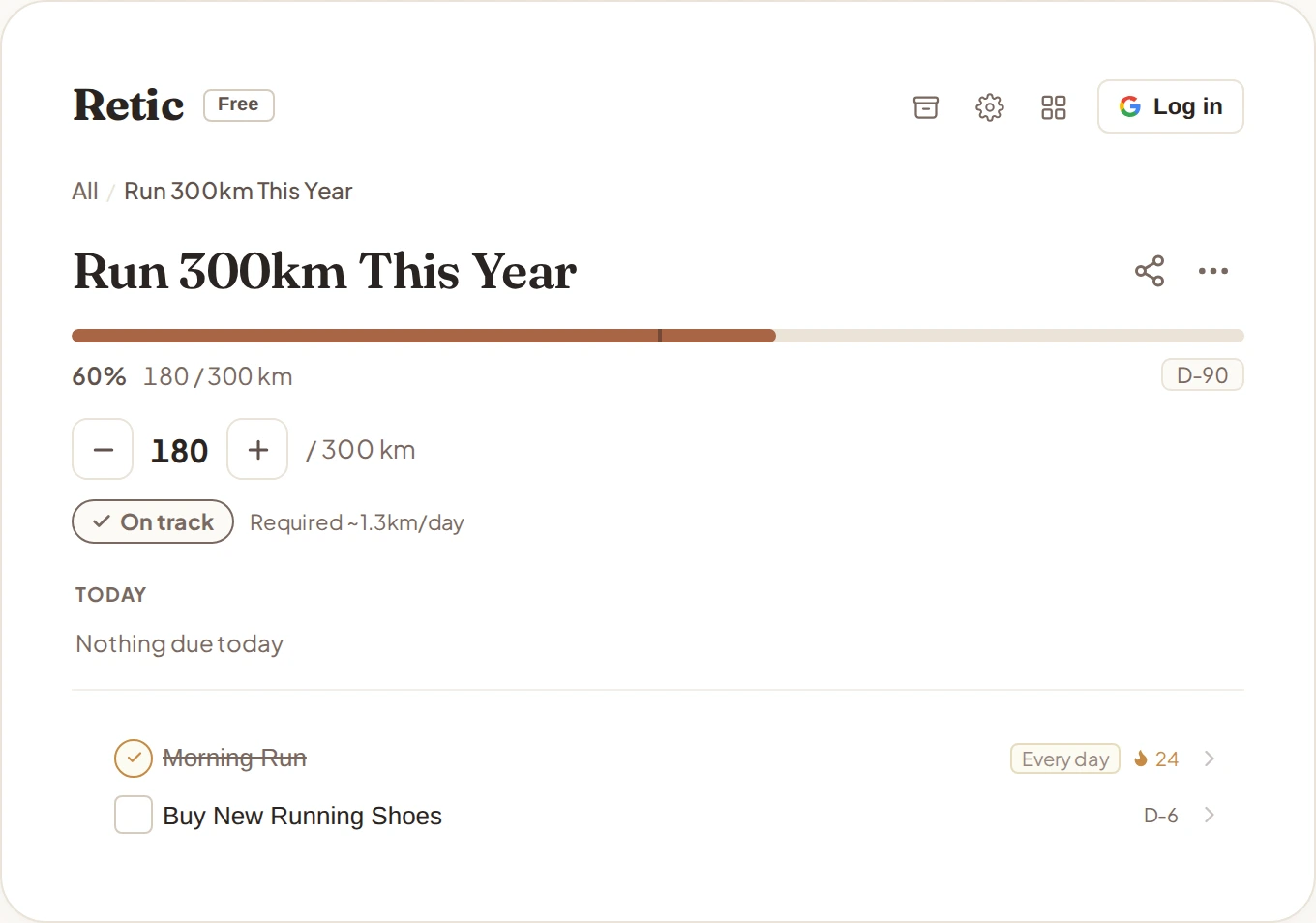
In Retic, tasks, habits, and goals are connected as a single tree. What you check off at the bottom flows straight up, so you can always see which goal any item on today’s screen actually feeds into.
NOTE Branches don’t all carry the same weight
A parent goal’s progress isn’t a plain average of the items directly beneath it. Each branch counts in proportion to how many bottom-level items hang off it, so a branch holding ten sub-items and one holding a single sub-item don’t move the number by the same amount.
Completion never gets separated from progress, and you never lose track of where today’s work is headed.
When those two things stay together, a checkmark stops being just a record.
It becomes proof that you’re actually getting closer, which is also why tapping that checkbox on the train home stops being an anxious wait for whatever the next screen shows.