
Look at the phone of anyone who’s serious about self-improvement and you’ll usually find two apps doing the job. Goals live in Notion or a notes app.
Habits get checked off in something purpose-built, like Streaks or Habitica. Both are perfectly good tools on their own. The trouble is, they don’t talk to each other.
”Wait, where am I on this month’s goal?”

You write “Run 80km this month” in Notion, and every time you finish a run, you check it off in Streaks. For the first few days, this works fine. Then, about two weeks in, a question pops up:
“How many km have I actually run so far?”
To answer it, you’d have to open Streaks, count the days you checked off, recall roughly how far you usually run, do the math, and copy the number back into Notion.
The habit is being tracked. It just isn’t connected to what the goal is actually measuring.
Do that math by hand enough times and you eventually stop doing it. You keep checking off the habit, but the goal’s actual progress fades into the background.
What’s left is a vague feeling that you’re “running, probably,” with no real confidence you’re on pace.
Why the two apps never connect
This isn’t a case of picking the wrong app. Outliner-style tools like Notion are genuinely good at free-form notes.
Habit apps like Streaks are genuinely good at visualizing consistency. Each is just doing its job.
The problem is structural. Goals and habits were never treated as the same kind of data to begin with, so checking off a habit has no way to change a goal’s state.
No matter how carefully you set up both apps, the only thing connecting them is your own memory and manual math.
Research from UC Irvine’s Gloria Mark finds it takes about 23 minutes to fully return to a task after switching away from it, and every trip between Notion and Streaks to copy over a number pays that same switching cost.
Manual math survives a few days, not a few months.
WARNING Don’t try to duct-tape a sync with Zapier or the API
A common next move is wiring Notion and a habit app together with an automation tool. But that connection breaks silently the moment either app renames a field or changes its API schema, and now maintaining the automation itself is one more job stacked on top of the original problem.
Would stuffing habits into Notion too help
Once going back and forth between two apps gets old, some people try the opposite direction: model habits as rows inside Notion too.
The back-and-forth disappears, but a slightly different-shaped problem is waiting.
Notion has no dedicated habit-tracking feature, so recurring habits still mean manually creating a row per date or setting up a recurring template, and pulling a habit checkmark up into a goal’s progress still means designing your own rollup and formula.
You’ve merged into one app; the wiring problem itself is still there, just wearing a different shape.
We cover this exact wiring problem in more detail in Why Tracking Goals in Notion Falls Apart.
Sometimes one app isn’t enough either
Merging into one app doesn’t make the problem disappear entirely. Plenty of task apps put goals and tasks on the same screen while still treating them as separate lists internally.
If there’s no link between checking off a task and updating the progress of the goal above it, being in one app isn’t enough by itself.
Either way, whether it’s one app or two, if there’s no channel for a checkmark to flow up into the item above it, you get the same result.
That exact feeling, a checkmark clearly recorded somewhere while the goal screen stays frozen, is the same situation covered in You Checked It Off, So Why Didn’t the Goal Move?
What if completion was progress, automatically

Imagine if finishing today’s task automatically updated the goal above it. You finish a run, check it off, and the progress bar for “80km this month” fills in by exactly that much.
No counting, no copying numbers. Completion is progress.
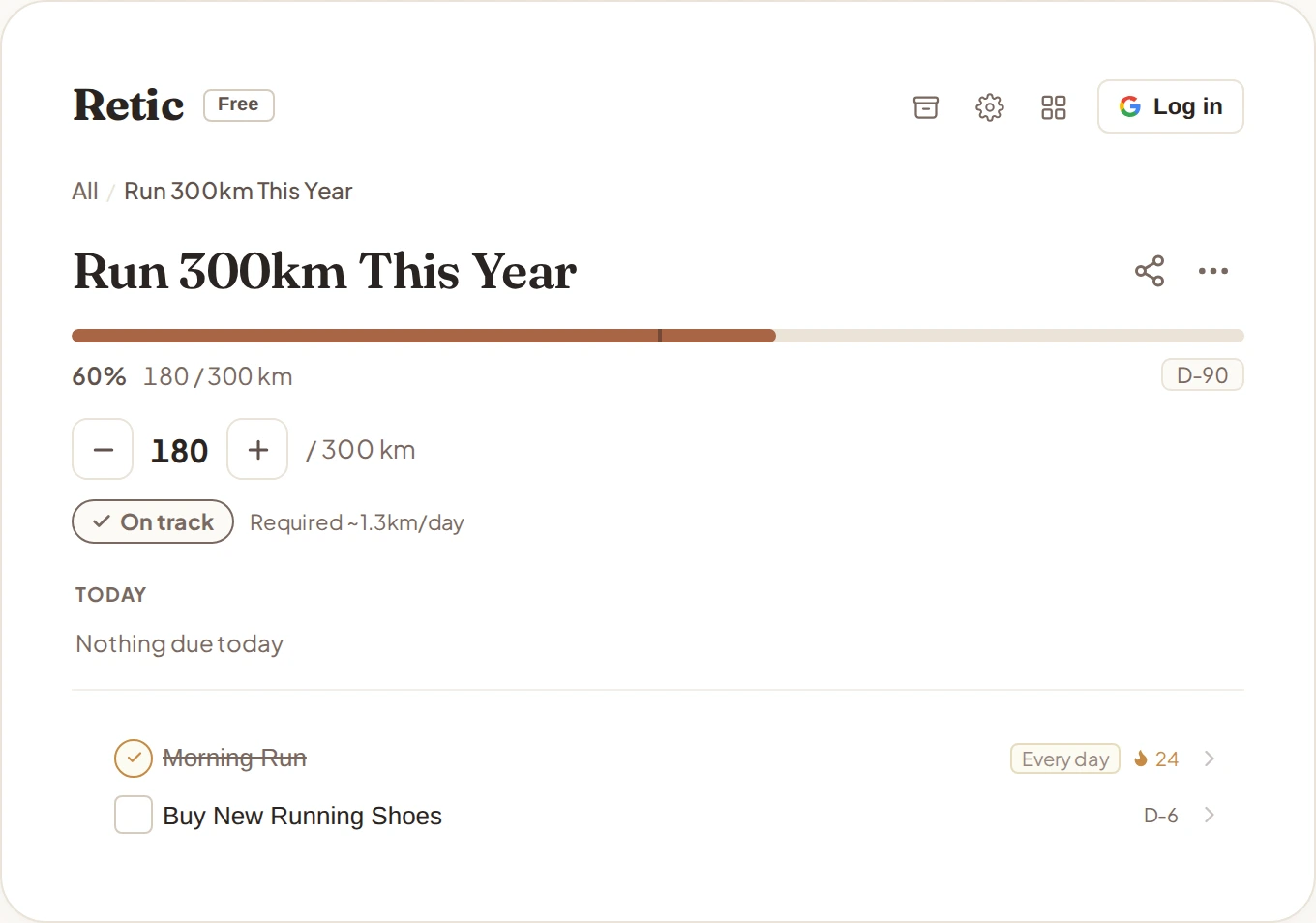
Retic manages goals, habits, and tasks as a single tree.
Nest smaller goals, tasks, and recurring habits under a bigger goal, and checking something off at the bottom flows all the way up automatically.
NOTE Habits sit out of the math on their off days
Once a habit hangs under a goal, only the habits actually scheduled for that day enter the progress calculation. For a three-times-a-week habit, the off days drop out of the average entirely, so a day you deliberately planned not to practice never drags the goal’s progress down.
Different goals can also be measured differently, some as a running tally, others as a simple done-or-not, so each one gets shown the way that actually makes sense for it.
More than anything, you can always see which goal any task or habit on today’s screen ultimately feeds into.
You never lose track of where today’s work is actually going, which is what replaces the habit of doing math between two apps in the first place.
Ask yourself whether you can answer “how many km have I run so far” right now without opening a second app or doing any math, and you’ll know whether your current setup is actually enough.
If you’re tired of manually calculating progress between two apps, or even within one, it might be worth seeing what a goal-and-habit structure that’s connected from the start looks like.