
If you’ve ever built a goal-tracking system in Notion, this will sound familiar.
You create a new database, add properties for goal name, deadline, and progress, and arrange it into a nice gallery or board view.
For the first few days, the system itself feels satisfying, like you’re already managing something. About three weeks in, you stop opening that database.
The moment the progress property betrays you

The most common pattern goes like this: you create a goal like “write 12 blog posts this quarter” and decide to type the progress number in by hand.
Every time you finish a post, you go back to the database and manually change it from “1/12” to “2/12”.
If you’re splitting the goal into subpages, you might reach for something fancier: a rollup property that counts checked subitems, and a formula property that turns that into a percentage.
It looks elegant when you first set it up. Then you restructure your subitems, or slot in a new sub-goal, and the rollup reference breaks. Now you’re back in there rewriting the formula.
Notion’s own documentation notes that formulas break silently when a property they reference gets renamed, so you have to reopen the formula and re-select it yourself.
WARNING Delete the relation property and the whole rollup disappears
A rollup can’t exist on its own — it always depends on a relation property pointing to another database. Restructure that related database, or delete the relation by accident, and it’s not just a formula going stale: the entire progress calculation blanks out at once.
Eventually, managing the goal and managing the goal-tracking system become two separate jobs. The more time the second one eats, the less enthusiasm is left for the first.
Productivity writers describe this same arc often: an enthusiastic setup, a two-to-six-week honeymoon, then declining maintenance as properties, relations, and views pile up, until the system quietly gets abandoned.
This isn’t Notion’s fault
Notion and outliners like Workflowy were built to be free-form document and database tools. Being able to shape any structure or property you want is exactly their strength.
But that freedom comes with a cost: progress calculation between a goal and its subitems doesn’t happen on its own. You have to wire it yourself, with rollups and formulas.
Looking at these tools as of June 2026, hierarchical goal structures exist at a basic level, but none of them automatically roll completion up to a parent item.
This feature is closer to something that was never on the roadmap in the first place.
Habit tracking fares no better. It typically means manually duplicating a recurring template. The tools themselves are excellent; the “completion equals progress” connection simply isn’t built in.
Does moving habits out of Notion help
Once people feel this fatigue, a common next move is to at least move habits out to a purpose-built app like Streaks or Habitica.
Checking off a habit definitely gets lighter, but a different problem shows up.
The goal still sitting in Notion and the habit record living in another app never talk to each other.
No matter how consistently you keep a habit, that record never automatically feeds into the Notion goal’s progress, so you end up with a brand-new chore: copying numbers back and forth between two screens.
You’ve only added a tool.
The math you have to do by hand is exactly the same problem, still there, and now that there’s one more screen to check, it gets even easier to skip that math some days.
We go into this in more detail in The Problem With Managing Goals and Habits in Separate Apps.
Defining a goal SMART-ly still doesn’t fix this
No matter how carefully you define a goal against the SMART criteria (Specific, Measurable, Achievable, Relevant, Time-bound), that definition doesn’t calculate progress for you automatically.
Type a goal like “grow quarterly revenue by 10%,” which satisfies every SMART criterion perfectly, into a Notion database, and the wiring that pulls how many subtasks are done up into that parent item is still on you.
Defining a goal well and calculating its progress automatically are two separate problems, and we cover that same gap from a different angle in Why SMART Goals Fall Apart in Practice.
Ultimately, the fatigue you feel in Notion isn’t because the goal was defined badly. It’s because there’s a blank left between definition and execution that a person has to fill in by hand.
Instead of wiring it yourself, it just works

In Retic, nest smaller goals, tasks, and habits under a goal, and one checkmark automatically updates progress all the way up. No rollup property to build, no formula to break.
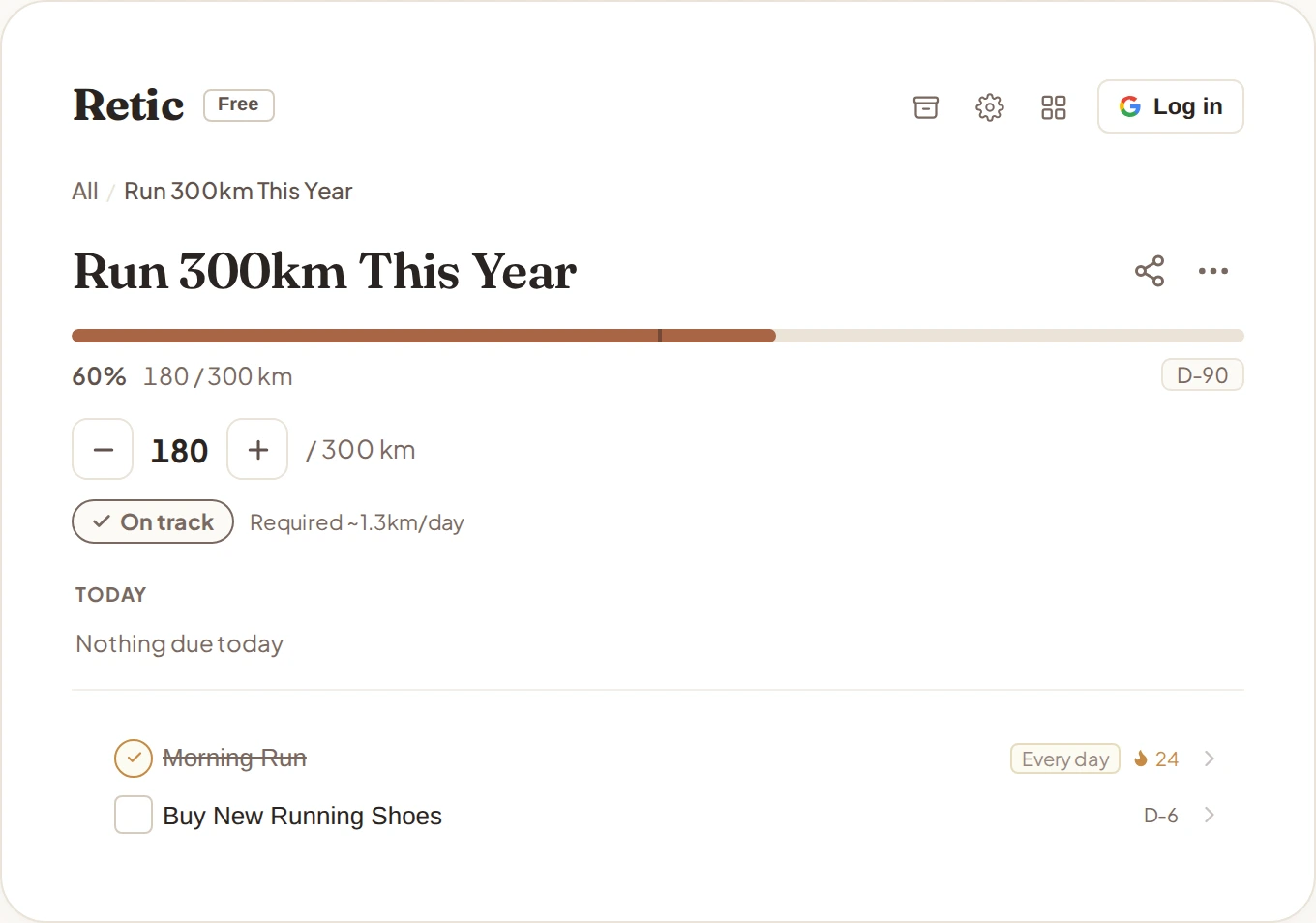
Write a goal, hit enter, and it’s already split into subitems, and if you restructure it later, progress calculation just follows along.
Getting back the time you spent maintaining the tracking system, and putting it into actually doing the goal: that’s the answer to the fatigue Notion leaves you with.
Think about the last time you had to fix a rollup formula in your own Notion database, and how far the actual goal fell to the back of your mind while you were doing it, and you’ll know right away whether that fatigue is still there.