
Recording “worked out today” is easy: check it off the moment you finish.
But how do you record “didn’t smoke today”? You’re being asked to log the fact that nothing happened, and nothing happening isn’t something you can actively log.
That’s exactly why avoidance habits (quitting smoking, no late-night snacking, cutting back on drinking) are unusually hard to track.
CDC data from 2022 found that 67.7% of US adult smokers wanted to quit and 53.3% actually tried that year, but only 8.8% succeeded.
Fewer than one in ten attempts pans out, which says something about how hard “not doing something” is to sustain on willpower alone.
Where check-off habit apps break down on avoidance habits
Most habit apps are built on the assumption “did it, so check it.”
Apply that same assumption to an avoidance habit and things get strange fast. Does a day you never opened the app mean you didn’t smoke, or just that you forgot to check in?
And on the day you actually gave in and had a cigarette, not many people feel like actively logging that in the app.
So the failed day quietly falls out of the record, and the streak ends up inflated beyond what actually happened.
Leave ordinary days alone, only touch the day it breaks

Handling an avoidance habit properly means flipping the approach.
Instead of “check it when you do it,” an ordinary day holds automatically, nothing to touch, and only a day you actually give in gets actively logged as a slip.
A day you fought off temptation at a rough dinner holds automatically, and so does a quiet, uneventful day where nothing came up at all. A day you slipped only counts as broken once you honestly log it yourself.
Making someone confirm “held today” every single night tends to backfire: it keeps putting the very thing they’re avoiding back in their head, and every night they forget to check in chips away at whether they stick with the tracker at all. The motivation in an avoidance habit comes from watching an unbroken streak count climb, not from a nightly checkbox.
So the ambiguity gets removed at a different point. A streak doesn’t inflate from skipping a nightly check-in; its accuracy depends on whether you honestly log the moment you actually give in. Resetting the streak on a slip depends on that same self-report, and uncomfortable as that is, it’s what makes the next attempt actually mean something.
Part of why avoidance habits are especially hard connects to what Charles Duhigg calls the habit loop: cue, routine, reward.
Breaking a habit doesn’t remove that loop; it’s an attempt to interrupt an already-automated routine, so the craving tied to the cue and reward is still very much there.
TIP Time it to peak temptation, not the morning
Set your reminder for whichever moment temptation actually peaks, late evening for snacking, right after work for drinking. A nudge right at that moment does more for an avoidance habit than a generic daily reminder.
Why check-off and numeric habits need a genuinely different approach
A check-off habit like “stretch in the morning” is fine with check-it-or-leave-it-blank.
A numeric habit like “drink 2L of water” is about how much you filled in today. Avoidance habits start from a different place than either one.
Check-off and numeric habits both, ultimately, record that you did something, while an avoidance habit has to record that you didn’t.
That’s exactly why borrowing a check-off app’s frame gets you the problem covered above: a day you never opened the app becomes indistinguishable from a day you actually failed.
Why each habit shape genuinely needs a different approach, and how to handle all three, is covered more broadly in A Checkmark Isn’t Enough: Three Ways to Track a Habit.
NOTE Off days neither break the streak nor extend it
An avoidance habit’s streak only considers the days the habit is active. If you scoped it to weekdays only, weekends drop out of the judgment entirely: whatever happened that day, the streak is neither broken nor advanced, it simply skips past.
What happens after a slip matters more than the streak itself
No matter how carefully you manage it, an avoidance habit eventually has a day it breaks. What actually matters at that point isn’t the fact that it broke; it’s what you do the next day.
James Clear’s rule in Atomic Habits is “never miss twice.” Slip yesterday but hold today, and you’ve already stopped a one-day failure from hardening into a two-day pattern.
Treating the moment a streak resets to zero not purely as proof of failure, but as the point where the next day honestly starts over again: that’s where the staying power of an avoidance habit actually comes from, not an unbroken streak, but how fast you recover from a slip.
How Retic handles avoidance habits

When you create a habit in Retic, you can pick “avoidance” as its own type, distinct from check-off or numeric.
An ordinary day with no record automatically holds, and only a day you actually give in needs a slip logged, at which point the streak recalculates to match how this type actually works.
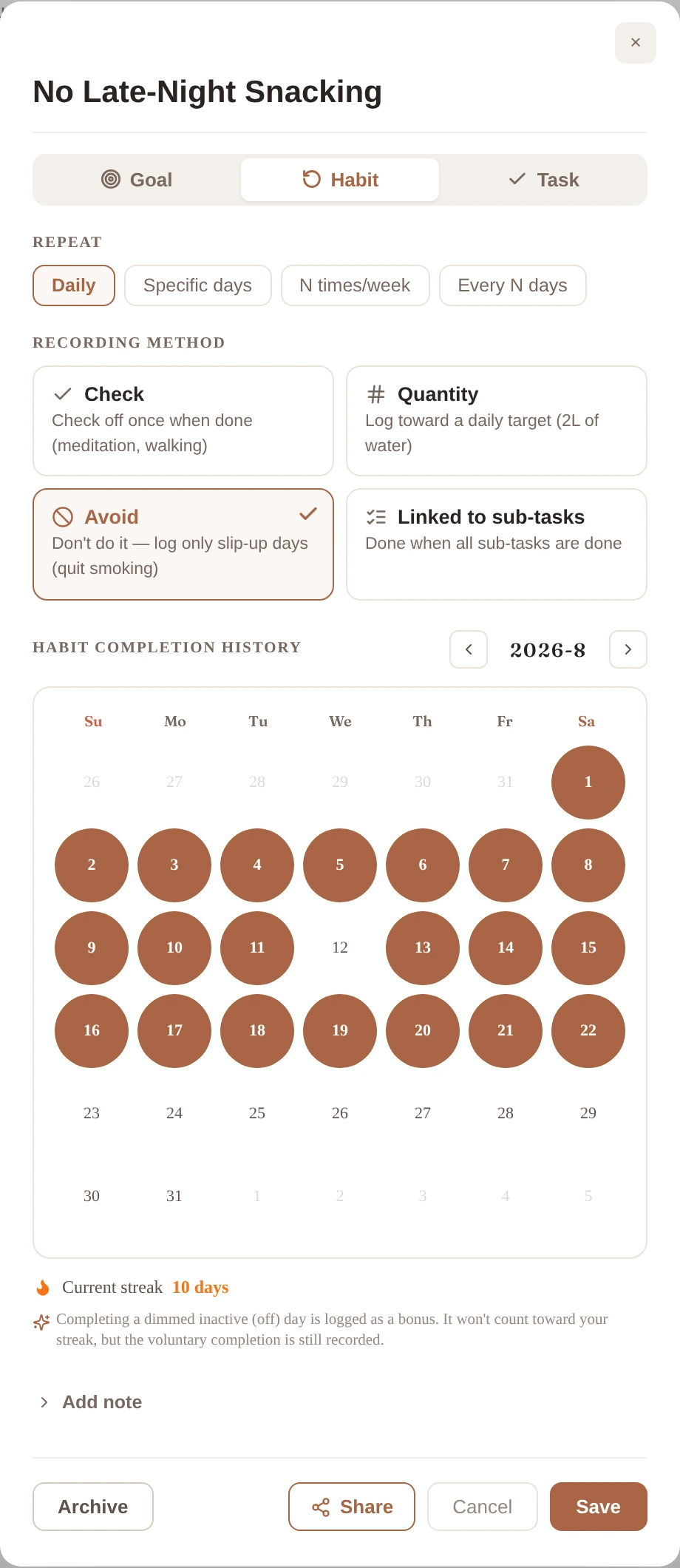
Instead of forcing an avoidance habit into a check-off mold, it gets handled in the shape it actually has.
If you’ve decided not to do something, honesty isn’t about a nightly check, it’s about the moment it actually breaks.
A day where nothing happened holds automatically without you touching anything; only a day you give in to temptation needs you to log it yourself, honestly, before starting fresh the next day. An avoidance habit really comes down to repeating those two things.