
Most habit trackers on the market handle habits exactly one way: did it today, check it off; didn’t, leave it blank.
But run through the habits you’re actually trying to keep, and you’ll find plenty that don’t fit that shape at all.
UCL psychologist Phillippa Lally’s 2010 study found habits took anywhere from 18 to 254 days to become automatic. Habits that vary that much shouldn’t all be measured with the same single checkmark.
Simple check-off habits

Things like “stretch in the morning” or “take a vitamin” are fine with a single checkmark.
What matters is the fact that you did it; whether it took 5 minutes or 10, how long it took is beside the point. Try to attach a number to a habit like this and all it adds is unnecessary overhead.
Numeric habits: you need to watch it add up to feel it

Habits like “drink 2L of water,” “do 50 push-ups,” or “read 20 pages” don’t work with a single checkbox.
Drinking 500ml and hitting the full 2L are completely different states, but a check-off flattens both into the same “not done.”
That difference needs to be visible and felt, or there’s no reason to keep going past the first 500ml to the remaining 1.5L.
These habits need a number you enter or accumulate, so you can see both how much you’ve done today and how much is left until the goal.
Do 10 push-ups five separate times, and the day’s total still adds up to 50.
TIP Torn between check-off and numeric?
A habit like “exercise” can sit awkwardly between the two. Ask whether tomorrow’s you actually needs to know how much you did today. If just showing up counts as the win, keep it a checkmark; if 15 minutes versus 30 changes what you plan next, track the number instead.
Avoidance habits: kept by not doing something
Then there are habits like “no late-night snacking” or “quit smoking,” where the goal is to not do something.
This is a completely different shape from either of the above, right from the starting point: the first two record that you did something, while this one has to record the opposite, that you didn’t.
And the fact that you didn’t do something is awkward to log actively.
So the approach has to flip.
An ordinary day, nothing eventful, holds automatically without you touching anything, and only a day you actually gave in to temptation gets actively recorded as such.
Making someone confirm “held today” every single night tends to backfire: it keeps putting the very thing you’re avoiding back in your head, and every night you forget to check in chips away at whether you stick with the tracker at all.
The motivation in an avoidance habit comes from watching an unbroken streak count climb, not from a nightly checkbox, so letting ordinary days hold automatically and reserving the honest, active moment for the day it actually breaks holds up better over time.
This type is tricky enough on its own that it deserves its own deep dive.
For how to actually record avoidance habits and what to do on a day it breaks, see How Do You Track Avoidance Habits Like Quitting Smoking or Late-Night Snacking?
Using all three together under one goal
These three styles aren’t only for different habits; they also work together, stacked by level, under one bigger goal.
Take “finish a marathon”: whether you finished is check-off, “60km this month” underneath it is a running number, and “run 3x a week” underneath that is a streak.
For the full process of splitting one goal by time period and picking the right measurement at each level, Breaking a Big Goal Into Small Habits walks through it using a marathon as the example.
Why each habit needs a different way of measuring it
Force all three into one mold and you end up losing something either way. Put a numeric habit into an app built for check-offs, and how much you did today disappears. All that’s left is did-or-didn’t.
Put an avoidance habit into a number-first app, and you’re left wondering whether “0” counts as success or failure, since avoidance habits succeed by not happening while numeric apps usually treat “0” as failure or incomplete, a direct collision of signals.
James Clear’s rule in Atomic Habits, “never miss twice,” is really about how fast you recover rather than an unbroken streak, and that’s a distinction a single checkmark struggles to capture at all.
A numeric habit is a little different here: it can show the degree of recovery.
Only hit half your target yesterday but fill 100% today, and that recovery shows up right there in the numbers, something a plain did-or-didn’t checkmark simply can’t record.
When you create a habit in Retic, you can pick whichever shape actually fits it: check-off, numeric, or avoidance. Water goes numeric, stretching goes check-off, quitting smoking goes avoidance.
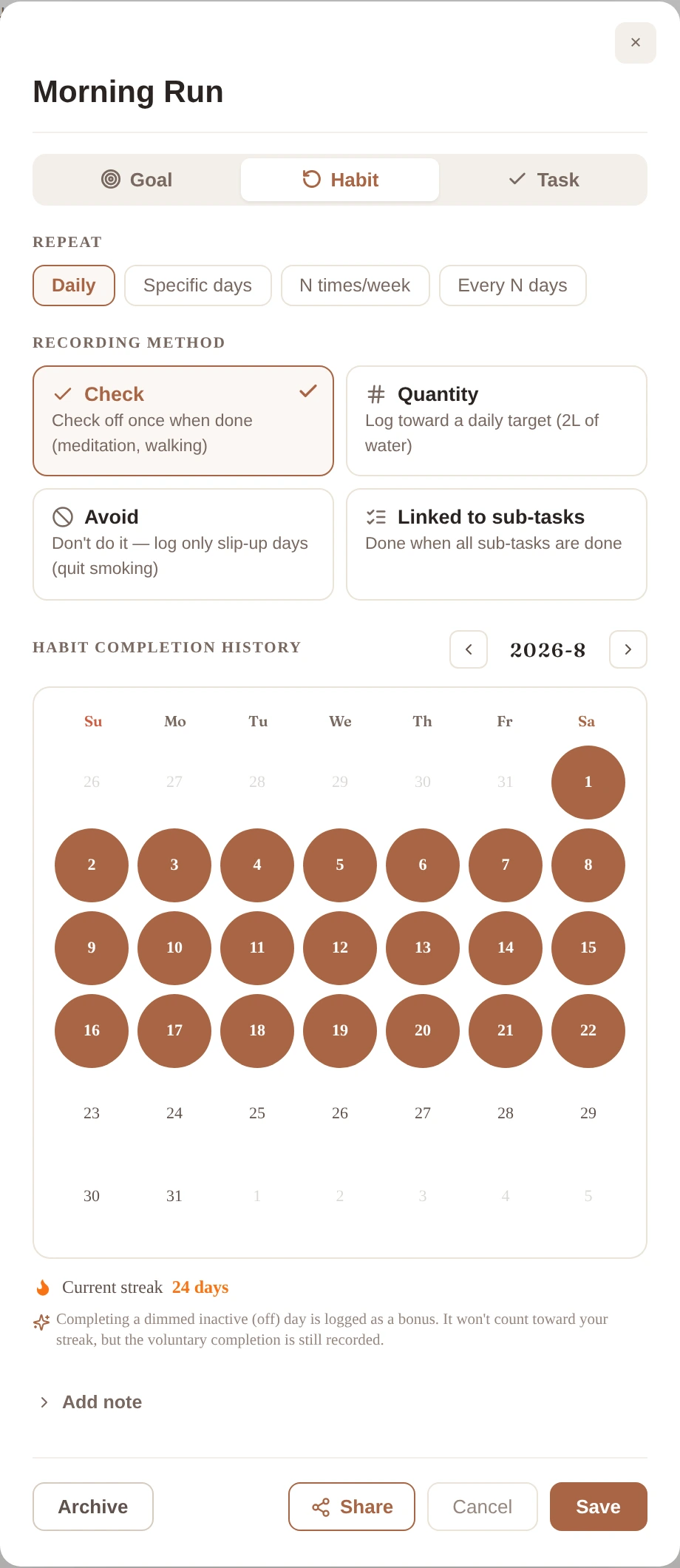
Each recorded separately the way that makes sense for it, inside the same app, and each one flows naturally into its own streak and progress.