
Habitica turns habit management into an RPG. Complete a task or habit and you earn experience, level up a character, and can even join a party to take on quests with other users.
That gamification is Habitica’s core appeal, and for anyone who responds well to game-based motivation, it’s a genuinely powerful tool.
Retic takes a different path: instead of game mechanics, it focuses on refining the structure of goals, habits, and tasks itself.
What Habitica is good at
Character growth, rewards, and party quests are real motivational tools for habit formation.
A task you’d rather skip feels a little more doable when you’re also earning experience for it, and working through quests alongside other people adds a sense of social accountability.
Habitica started in 2013 as “HabitRPG” before being renamed in 2015, making it one of the original gamified habit apps. For anyone this style resonates with, Habitica remains a distinctive choice.
Where the difference shows up in goal structure

As of a June 2026 review, Habitica manages habits, to-dos, and dailies as separate lists, without any hierarchical goal structure.
There’s no way to nest sub-items like “write my resume” or “study for interviews” under a bigger goal like “job search” and watch their progress roll up automatically.
Completing a task earns your character experience, but that completion never connects to the progress of anything bigger.
Gamification itself has a nuance worth noting.
Research grounded in self-determination theory has repeatedly found that game mechanics like points and badges drive extrinsic motivation effectively, but that effect tends to weaken over time.
The motivation that actually lasts tends to come from something more intrinsic, like an ongoing sense that you’re genuinely getting closer to a goal.
| Habitica | Retic | |
|---|---|---|
| Hierarchical goal structure | ✕ | ✓ |
| Habit tracking | ✓ | ✓ (check-off, numeric, avoidance) |
| Automatic progress on completion | ✕ | ✓ |
| Motivation style | Gamification (XP, party) | Visualizing progress toward a goal |
| Social features | ✓ (party, quests) | ✕ |
Based on a review conducted in June 2026. The competitive landscape is reviewed on an ongoing basis.
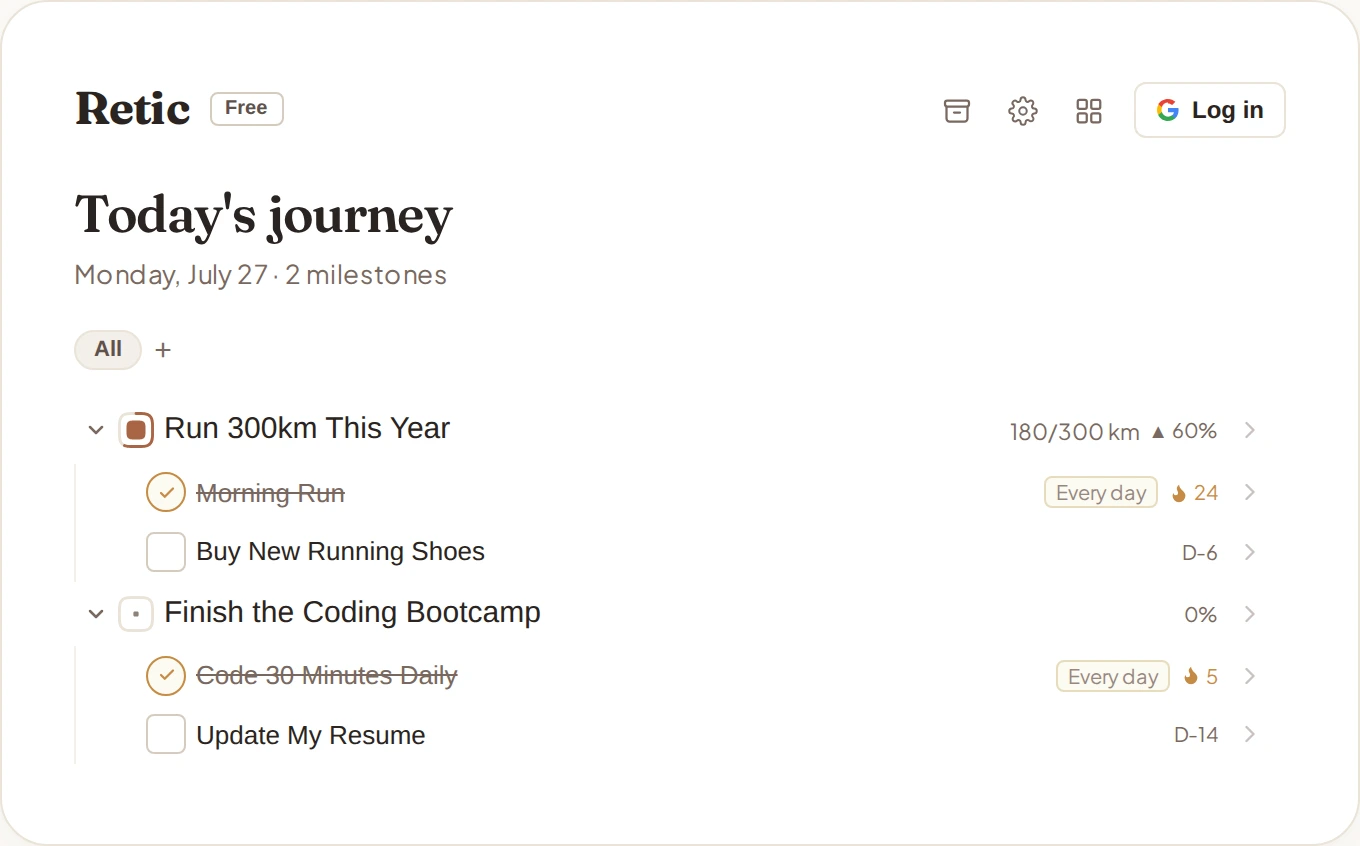
Instead of motivating through game mechanics, Retic focuses on showing, structurally, which goal today’s work is feeding into.
Completing a task fills in an actual goal’s progress rather than a character’s level, and because that goal’s sub-goals, habits, and tasks are all connected as one tree, you can always see where today’s work is actually going.
How does Habitica split up your to-dos, exactly
Habitica doesn’t lump everything into one list. It splits work into three types: Habits, Dailies, and To-Dos.
- Habit: a repeatable action where a plus click earns experience and gold, and a minus click costs your character health instead
- Daily: repeats on set days of the week and costs health the same way if you miss it
- To-Do: a one-off task with a deadline
TIP Map Habitica’s minus-only habits to avoidance type
If you’re bringing over a Habitica habit that only has a minus button, one you track by not doing something (like “no late-night snacking”), register it in Retic as an avoidance habit rather than a check-off one. Check-off is built for “I did this,” while avoidance is built for “I didn’t do this,” and matching the type to the behavior keeps the record accurate.
Both Dailies and To-Dos can carry a checklist of sub-items, though the two work differently: on a To-Do, each checklist item pays out like its own separate To-Do, while on a Daily, filling in more of the checklist reduces the penalty for not finishing the main item.
Treating “something you repeat every day” differently from “something you finish once” is a real strength.
But the three types don’t talk to each other, so there’s no way to build something like “repeat this Daily five times, and that finishes this To-Do (go to the actual interview).”
Each type’s completions add up to character experience, but none of them roll up into the progress of anything above them.
What happens once you’re running several goals at once in Habitica

Because Habitica has no per-goal folder or parent structure, people juggling multiple goals often resort to prefixing task titles with an emoji or tag to tell them apart themselves (like ”🏃 5K training” or ”📚 certification study”).
That makes the list easier to scan, but it doesn’t calculate what percentage of any goal is actually done.
The lack of any hierarchical structure at all echoes the gap we cover in our Retic vs Notion comparison: Notion at least has page hierarchy, while Habitica doesn’t even have that.
The more goals you’re running, the wider the gap gets between this manual sorting and your actual progress, and it’s not unusual to forget your own emoji convention a few weeks in.
So which should you use
If the fun of leveling up a character and the motivation of party quests genuinely work for you, Habitica is still an appealing choice.
But if you’re juggling several goals at once and want to see, structurally, how they connect to the habits and tasks underneath them, a tool built around hierarchy and automatic progress is the better fit.
Count how many emoji prefixes you’ve stacked up at the front of your Habitica to-do list right now, and you’ll get a sense of whether that manual sorting has already hit its limit.
If the plain, check-and-done simplicity sounds more appealing, our Retic vs Streaks comparison is worth a look too.